
Listener Questions About Anxiety and Recovery (Episode 84)
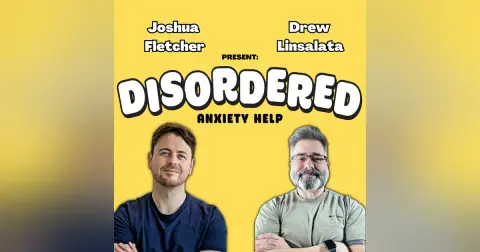

 Apple Podcasts
 Spotify
 YouTube
 Amazon Music
 iHeartRadio
 RSS Feed
 This week Josh and Drew are answering questions from Disordered listeners.
- How to deal with the shame associated with anxiety and recovery when a partner or spouse isn't terribly supportive.
- How do re-gain confidence in oneself?
- What happens if you don't remember what non-anxious you was like?
- What about flushing, feeling hot, and getting goosebumps when anxious?
- I'm an introvert. What do I do when I want to go home to re-charge? Is that avoidance?
- What about when you're facing possible medical issues and it triggers anxiety?
- What about anxiety symptoms that are disruptive and I don't know how to manage them or stop them? What is that? If its a panic attack, how do I stop it?
As always, this episode includes some wins from the community, and healthy helpings of humor and compassion.
---
Disordered Roundtables are here. Think of it as "Disordered Live", a way for members of our audience to spend time with us in an intimate virtual setting (attendance is limited) to engage in real time sharing and discussion on specific anxiety disorder and recovery topics. To be notified when new Disordered Roundtable sessions are scheduled, visit our homepage and get on our mailing list.
---
Struggling with worry and rumination that you feel you can't stop or control? Check out Worry and Rumination Explained, a two hour pre-recorded workshop produced by Josh and Drew. The workshop takes a deep dive into the mechanics of worrying and ruminating, offering some helpful ways to approach the seemingly unsolvable problem of trying to solve seemingly unsolveable problems.
https://bit.ly/worryrumination
-----
Want to ask us questions, share your wins, or get more information about Josh, Drew, and the Disordered podcast?
---
Disordered Roundtable is coming! Think of it as "Disordered Live", a way for members of our audience to spend time with us in an intimate virtual setting (attendance is limited) to engage in real time sharing and discussion on specific anxiety disorder and recovery topics. To be notified when new Disordered Roundtable sessions are scheduled, sign up for our email list using the form on this page.
I have a question. It's not that anxiety has come back during a setback, it's that we've temporarily lost confidence in ourselves. How do you go about regaining confidence in yourself?
SPEAKER_01What if non-anxious you is an introvert and so the default is to run back home to recharge?
SPEAKER_04This has something to do with symptoms. I get really like a red face, and also like I can get itchy all over my body and weird goosebumps.
SPEAKER_01When being kind to yourself and just accepting that I have a fear of fear, I don't know how to do so when my husband has no interest in learning more or helping.
SPEAKER_06When you guys say do what non-anxious you would do, what do you do in the case that you don't remember who you were before you got it?
SPEAKER_01Welcome to Disordered. This is episode 84, where we take your questions, answering listener questions. I'm Joshua Fletcher, also known as Anxiety Josh, and I'm a psychotherapist, an author who specializes in anxiety. A previous sufferer, co-host of this podcast, author of several books, and really excited because today is the first disordered roundtable, which we will be conducting after this recording. It's going to be great.
SPEAKER_02I am Drew Linsalata, the other co-host of this fine podcast. Um, I had anxiety disorders, depression, OCD for many years of my life, but now I'm better and I'm even a therapist now. Also, like specializing in anxiety and anxiety disorders. I'm in New York if you're in the neighborhood. What else? I've written books about this, I'm on social media, I do podcasts, all the things. And yeah, we're gonna answer some questions today. It's gonna be awesome.
SPEAKER_01If you're new to the podcast or a frequent listener, etc., we like to celebrate the community. Uh, we're going to dedicate today's episode um and obviously answering your questions, but also we like to celebrate wins as well. Do we have any uh wins uh lined up to kick us off today?
SPEAKER_02We do. Let's listen to one, but I gotta do a little bit of how come it's doing this. Thank stick with me, guy.
SPEAKER_01Did I just put you on the spot? I'm really sorry.
SPEAKER_02Stick with me, bra. I have to get my here we go. Now we're gonna solo this one and it's good. All right, let's listen. Here we go.
SPEAKER_05Hi, Drew and Josh. This is Katie. I'm in Arizona in the United States. I wanted to share a quick win. Oh, you can use my name if you want, but I wanted to share a quick win. Um, this past weekend, my daughter had a university tour about two hours north of where we live. And everyone in my family wanted to make it just a day trip, but me, I was like, no, we're gonna do this overnight and make it a two-day or three three-day, two-night trip. And traveling for me is a big trigger. I've even before my anxiety disorder, traveling has always been something that has caused me anxiety. So for me to really push it is a big deal. And I'm really happy about that that I'm able to do that because it's something that I want to enjoy and my kids enjoy. We went up there and we I was able to participate in all of the events, even with an anxious stomach. I'm not gonna pretend I wasn't anxious the entire time. It went up and down the whole time, but I still participated in all of the events, was there for my daughter for everything. We went hiking in the mountains up in the falls.
SPEAKER_02Why? What is up with that? Let's keep going.
SPEAKER_05Did all of the things beyond even the college tour. The second night we were there, I had one of the biggest panic attacks I've had in years, and I was able to think of you guys actually, and how you talk about the peak of a panic attack and the come down. And instead of spiraling into that, this is the beginning of the end, I was able to remember that, and it did. It peaked, it ended. I went to sleep, enjoyed the next day, came home. It was great. So I just really appreciate everything you guys do, and thank you so much. I was able to enjoy a weekend away with my family. Woo!
SPEAKER_01Yeah, that was amazing. Um all I heard was I was having a panic attack and I thought of you two, and then my panic peaked.
SPEAKER_02Only go boy, which is natural. That's what you don't want. In the middle of a panic attack. That was great, Katie. Good job. Thanks for sending it in. Well done. Nice, Katie, from my social media community. And I know that this was a big deal for her. So good job, Katie.
SPEAKER_01Superb. Well done. Let's get stuck into some of the questions. I'm gonna start us with a written question. I don't really shared any of these with Drew as well. So we keep them. We don't really, there's no professional vetting process between here. Yeah. Um, if you haven't, can tell. Sometimes sometimes the podcast lacks a bit of professionalism, but that's fine. Um uh don't forget the uh sound effects as well. Uh quite um, I mean, that is professional, isn't it? Hi, you too. Feel free to use my name. All right, Karen, we'll do. I have I I have anxiety and I struggle with, along with ADHD and RSD. Um, I love the podcast and find it very connecting, helpful, and kind. Thank you. I have a question. When being kind to yourself and just accepting that I have a fear of fear, I don't know how to do so when my husband has no interest in learning more or helping. I then circle back and feel shame and frustration and on and on. Any specific information for such situations? Thank you. That's a really good question.
SPEAKER_02That's a tough spot to be in, too. Sorry, Karen. Yeah.
SPEAKER_01Where would you stop?
SPEAKER_02Well, I think if I'm gonna get philosophical about it, I think being kind to yourself really comes from inside you. It cannot be predicated on what other people are doing, I think. So that's the first thing that came to mind was like cultivating the ability to like accept yourself for what you are in any given moment has to be internally generated in the end. It has to be. It cannot be predicated on what other people are doing. Now, if they are harming you or abusing you or like, you know, beating on you, whether it's physically or emotionally while it's happening, that's a different story. They do start to factor into that, and it would be really hard to find some kindness when you're under the gun. But, you know, he doesn't, he doesn't want to learn anymore and he's not terribly supportive. That's not good. I mean, it would be nicer if he was more supportive, but I think you got to start from the premise of you gotta you gotta understand that it has to be generated internally. And then from there, where would you go with this?
SPEAKER_01Yeah, I'd also look at you know the shame part of things, which is also good to bring to therapy. Why would you feel ashamed in response to the apathy from your partner? It doesn't make your experiences any less valid. Uh, maybe there's a lack of understanding there, and maybe there's some communication that can be built with with your husband around it. But I'd look at the shame bit. We talk about hurdles to recovery and feeling shame uh and loneliness can be one of those things. But also remember it's you that's got to receive the credit for overcoming anxiety, and there's almost like a bittersweetness to it. Now, yeah, it's not nice when your partner doesn't want to get it, and that's something for for you to reflect upon you know if it works for you or not, and if it maybe it's just the dynamic that you have in your relationship, and maybe it's good in other parts of your life, but for this part of things, the bittersweetness is when you do overcome anxiety, which you will, you'll get the credit for it. Now, the on the flip side of things, uh you can have an apathetic partner, or maybe even a partner gets annoyed and frustrated, but then you can also have the savior partner who is as obsessed of trying to get you better, and that can also be a hindrance. So sometimes and if you're lucky enough to have a supportive partner that can gauge the boundaries right on to learn fair play to you. But in this case, I would say, right, this is the situation. There's apathy for my partner, but what can I do to be kinder to myself and be able to get to a good place and ask for help in an appropriate way if I need to and if I can get it? You can still recover. And I the first port call would be to maybe explore that shame because you're nothing to feel ashamed about if you if you experience anxiety.
SPEAKER_02Yeah, I would agree. I I think you can almost lean if you need like a rock to stand on to start, lean on the idea that like you are allowed to be human. So being anxious, having maybe mental health issues, feeling big emotions, being afraid, feeling a child. Like that is a human experience. Like it's not failure to be anxious. It's not even failure to be anxious in a disordered way. Like, you know, we talk about this stuff all the time. Is it an illness or is it just like a natural mechanism that sort of veered off course a little bit and has to be corrected? So, you know, that whole like, well, I'm failing just because I feel this way and I'm ruining his day, and he's impatient, and I'm you're not making it easy on him and I'm making it, you know, I'm not good enough for him. Well, you're allowed to be human. Start from there. This is a human experience I'm having right now. Can I allow that?
SPEAKER_01Yeah, and also reflect on is this good enough for me? Oh, good point. That's a really good point, right? Mm-hmm. Yeah. If you asking for compassion and empathy from your partner is not unreasonable, then is it good enough? Anyway, I'll leave you with that, Karen.
SPEAKER_02Very good. Good question. Thanks for sending it in. Uh, should we do an audio one? Okay. Let's do it. Let's do this one. Let's make sure that it works this time. Here we go. This program is really not happy today.
SPEAKER_06Hi, Jira and Josh. Um, firstly, thank you so much for everything that you both do. I appreciate you guys so much. Um, and with your help, alongside a very brilliant therapist, I've been working on exposures and easier said than done, the willful tolerance of anxiety. And I am yeah, trying to claw my way back from what has been a quite debilitating few years of health anxiety and agrophobia. My question is when you guys say do what non-anxious you would do, what do you do in the case that you don't remember who you were before you got it? Um, I was in my early mid-20s when I first started to get really anxious, and now in my early 30s, I'm wondering who I am now without an anxiety disorder. I'm definitely a different person to who I was in my early 20s, but whether or not that is just an age thing or because the anxiety has really left its mark on me, I don't know. But I'm wondering if you've got any tips for yeah, doing what non-anxious you would do when you can't quite remember. Sorry if that was a bit rambly, but thank you again.
SPEAKER_02That wasn't rambly at all, Glara. That was a great question. What do you think about this? Leave the rambling to us. Yeah, yeah, we're here for that.
SPEAKER_01Why don't you start with that? No, I want you to answer. Oh, I'm fine with that.
SPEAKER_02Oh, you go first. No, you don't.
SPEAKER_01Who's what do you do if you don't know what non-anxious you would do? Um approach it with curiosity. Why don't you discover what non-anxious you is about with curiosity and a trial and error approach to things? Drew and I speak about it a few times. I don't know, maybe use your imagination a little bit with curiosity. If you've got an anxiety disorder for a long time, you've probably lived very isolated, insular, very inwards, kind of forgotten how to engage with the outside world, with other people, with hobbies, interests, and likes. Why don't you just dip your toe in and see if you like it or not? You don't have to get it right. Maybe you want you maybe you don't like line dancing, but you tried it anyway. Maybe you're into battle reenactment, but you go along and realize, eh, it wasn't for me, maybe it was. Maybe you want to go down to the karaoke bar and murder your favorite musician, metaphorically. Who knows? I always say approach with curiosity and trial and error.
SPEAKER_02I can't add much to that, except if you do try battle reenactment, please send us a video because we're gonna need that. And I think be careful about demanding an outcome. I think that's a thing that you know, people further down the road into that recovered state sometimes get caught in that. Like, well, I used to really love such and such, and then they might try that hobby again, and they don't hate it, but they don't they can't feel this like huge thrill from it, and then they discount that. Like, oh, I didn't I didn't get the right feeling from it. Well, you know, be careful about demanding, I have to love it, I have to be thrilled by it. Maybe not. Oh, maybe you'll hate it. That's okay, but like it's okay to feel all the things sometimes super happy about it, sometimes just meh, it's a time killer, it's like it was something mindless. Like, all the experiences are allowed. That's the only thing I would add. Your answer was great, man.
SPEAKER_01Yeah. And also, maybe even like I I know we often bang on about like do what non-anxious you would do. I would change that slightly for this. And if you can relate to to Lara's question, I would change it to do what you think non-anxious you might do.
SPEAKER_02Yeah, that's really good. Because you're guessing and you're trying. You're the trial and error is 100% right. I don't know, so I have to try something.
SPEAKER_01I don't know. Yeah, and just yeah, and like like Drew said, just because you didn't end up enjoying it doesn't matter. Yeah, you've given your brain a new experience, you've you've come out of the old habits, you it it doesn't matter.
SPEAKER_02Yeah, there's a concept in in mindfulness called it's not just in mindfulness, it's in Buddhism and meditation, all those things too, like called beginner's mind. Can you cultivate beginner's mind? In the beginner's mind, there are many possibilities. In the experience mind, there's only one, but like, no, go back to the beginning where like anything is possible. I'm a big fan of beginner's mind.
SPEAKER_01All right, should we do another one? Good question. Yeah, kick them enjoying these questions. And if um you have did it anyways and questions, send them in over to disordered.fm and we'll get and we'll get the way through. I'm sorry we can't respond or play them all, but we try our best and um we really appreciate you sending them in regardless. We do. I have one I can read.
SPEAKER_02Might as well. Okay. Here is hi Josh and Drew. Hope you're both doing well. I have a question. How do you go about regaining confidence in yourself? I've heard you say that it's not the anxiety, it's not that anxiety has come back during a setback, it's that we've temporarily lost confidence in ourselves. I've definitely observed that in myself. The times I thought I had recovered, I was giving credit to the people around me. When away from those people, the anxiety comes back. Now I'm trying to give myself more credit. But what are some other ways we can rebuild confidence in ourselves that we can handle whatever will happen? Thank you both so much. Thank you. Questions under enter. That's a great, great, that's a huge question, though.
SPEAKER_01That's a big ass question. Yeah, confidence in yourself. Well, I think identifying the first point is you know, identifying actually I've given credit to other people for my feelings, particularly related to an anxiety disorder. Like maybe they've got the credit for me feeling calm. Yeah. And so I'd say, well done for identifying that. Um building confidence. Where would you go from that situation?
SPEAKER_02I I have I have thoughts on confidence. I do not think that you get to decide to be confident. You can only learn that you can be confident through experience. So many moons ago in The Anxious Truth, my other podcast episode, I wrote about the three C's of recovery. The first one is courage. That's what you need to get the ball rolling. The second one is competence. You begin to feel competent in your own skin. Yes, I can handle getting through the peak of the anxiety and the panic and the intrusive thoughts and the OCD. Confidence is the third C, and it only comes after repeated displays of competence. So competence is current knowledge of your ability. In this moment, I could do it. Confidence is just future competence. So I've done it so many times that I know that when it happens again next Tuesday, I'm I got this. I love that. What more episode's that? That's a good idea. I would have to look at that. It's probably a couple of years ago.
SPEAKER_01Episode 9033 of the anxious truth.
SPEAKER_02It was recorded about through rants about something. It was the fall of the Roman Empire. Then I did that episode, I believe. But I I think instead of trying to feel confident, just go be competent. And confidence comes from that. Oh motivation comes after action, and confidence does also. So just be competent and confidence will come. I told you every 17 episodes you come out with a bang. I love that. I show up every Friday and like once every six weeks I get a good one. So it's a good thing. That's a really good question, though. I think that question goes way beyond just people with anxiety disorders. How can I build confidence? Well, you take risks, try stuff, see how you do, like give yourself some credit, adjust if you have to, learn from your mistakes, and then you start to feel competent. And almost anything we do, that's how we learn.
SPEAKER_01Yeah. I love that. I can't, I can't add anything to that. Um, maybe make a mental note to give yourself a pat on the back. Sometimes it will feel forced, but when you get into a habit of having this kind of positive reflection on what you've done, that can also boost things as well.
SPEAKER_02Maybe awareness of negative bias, which all humans have, by the way. If you can build an awareness of the negative bias, that helps too. Because it's hard to feel competent if all you want to go to right away is oh, how it felt. How it felt, how it felt.
SPEAKER_01Yeah, all the perfectionists, Craig, the critics, like, well, I did the hard thing, but but it's Craig, the critic. Screw that guy. Immediate, yeah. Yeah, exactly. Straight to the to the what you didn't do. Uh yeah, I'd observe that that cognitive bias. Thank you. Great question. Yeah, what else we got? You want to read one?
SPEAKER_02Should we do an audio? Uh let's do an audio. Let's do an audio. Which one should we do? Let's do this one because this one comes from like friends in Amsterdam. So here we go.
SPEAKER_04Hi, Jos and Drew. This is Allard from Amsterdam, the Netherlands, saying, Yes, you may use my name. First of all, I want to say big thank you, guys, because your podcast is really the best and it's so helpful. I have a question.
SPEAKER_02Before we get to the question, can I just say we do not know Allard, but I I would have a beer with this guy. Allard, if you're listening, you sound so friendly and I appreciate you. So I agree.
SPEAKER_04And this is has something to do with symptoms. I noticed that you know I get really like a red face, and also like I can get itchy all over my body and weird goosebumps. And of course I went to the doctor, the doctor doesn't see anything and pa pa pa stuff like that. So I went through all that, and then suddenly I was thinking, oh my gosh, is this also a symptom of anxiety? Is this another symptom of anxiety? And I wonder if you guys know something about that, you know. Um I hope you can talk about this, and once again, thank you so much. Big fan of you guys.
SPEAKER_02Well, that's a really good question. They're all good questions.
SPEAKER_01Yeah, so getting red faced and then suddenly getting goosebumples and and sort of things. Yeah, very common symptom of anxieties. Do you ever have it, Drew? Uh, the red face, the heat.
SPEAKER_02Oh, yeah. The heat, especially. Like it literally felt like somebody turned on a furnace, like in my chest, and I would just be on fire top to bottom. It would spread out and I would just be burning.
SPEAKER_01Yeah, I had that, but then interestingly, uh, my extremities would be cold. So like I'm sweating, and my torso's boiling, and then my feet feel like they're in buckets of ice. My hands feel like cold because, well, there's a there's an explanation around for it. It's the redistribution of blood around your body and into your muscles, etc., um, due to fight or flight, you know. So, yeah.
SPEAKER_02You know what's fun about that too? That the heat would cause you to sweat, and then the sweat evaporates, and then you get those cool patches, or maybe there's a breeze, or there's a fan, or the AC is on, or whatever, and it's like, and then there was like, oh my god, I'm hot here, but cold here. What's going on? We freak out.
SPEAKER_01So, yeah, and it's not helped by that hyperfocus of the self either. Um, also, I knew a panic attack finish when I started feeling cold, because yeah, you like you've you're sweaty and you perspire, and then yawning and cold. Have you noticed every the end of every panic attack? You start yawning. I love it. So if I'm ever really anxious, which is rare nowadays, but if I ever ever get uh anxious and then I start yawning, I'm like, ah, this is passing because the adrenaline's passing, I'm tired and I'm cold, so I've obviously been very anxious. Um, yeah, it's okay. Those symptoms are okay. We go with it, we practice the willful tolerance of it, we know why it's happening. The brain's redistributing blood to the major muscles just in case we need to run away or fight a predator. Um, the only predators in Amsterdam are the cyclists. I've almost been killed seven times by a cyclist in Amsterdam, mostly because of my own incompetence and spatial awareness. But um, in general, yeah, that's okay. Try not to add secondary fear to it. And listen to the primary secondary fear episode that we did last episode, I think, was it? Oh no, it's the episode before. Can't remember. Um, but yeah, it's okay. I accept that that's a symptom. That's it. I don't need to do anything. But when we start hyperfocusing on the symptom and the social ramifications of it, and we start to fix out on it, that's when it can stick around a bit longer and become a thing. Yeah, good point.
SPEAKER_02The flushing, that's so common. In fact, a lot of people then wind up feeling like the flushing itself, it's not dangerous, but they see it as embarrassing. Like the people like when they get really anxious, they get really flushed, they get red faced, and then they're they want to hide because they they could tell everybody knows that I'm anxious. They know that something's wrong because look at my face. Um, another thing that's interesting, I find it fascinating. Scared Brains can trigger so many different things bodily, right? Physiologically. So the weird goosebumps could just be a temperature thing, or people get hives. There are people who just break out in hives when they're really stressed and anxious. Yeah, chest and stuff. They're itchy and like it's all over my arms, or only once in my life, I think, did I ever really have like a stress-induced hives breakout. But yeah, it sucked. It was bumpy and itchy and red and looked weird, and I hated it. But yeah, that can happen. As long as you've been medically checked, of course, anybody who's listening, you always want to get medically checked. You got to get that. A lot of people listening have been medically checked a million times and still don't believe it. But like that is required. That is part of it. That's part of it. It was Dave Carbonell who like really gave me good advice when we were talking one time. He's like, No, no, you know, it's not even suggested, it's required. It's okay. You're allowed to go get checked by a doctor. You're not doing it wrong. Just you know, so yeah, as long as you won about four times in a week. Well, that's a different story. That's a different animal, but you got to start with the clearance, which I'm glad LR did. But yeah, really common. Just gonna have to flow, go with the flow on it.
SPEAKER_01Yeah, thank you. Great question. And uh thank you for the love sent from the Netherlands. Absolutely. You know, one of the most cycling friendly cities in the world. That's true.
SPEAKER_02So pay attention.
SPEAKER_01I told you there's nothing friendly about those cyclists. I I they weren't for blood. I was like, I'm crossing the road in the cafe, walk at the top. Is there someone cycling towards me? I was on the plane, someone cycling down the middle aisle, still after me. They wouldn't leave me alone on the bike, on the plane. Hordes of cyclists out for blood. No, I mean, that's not it's a beautiful city, really good. Highly recommend it.
SPEAKER_02Uh, what do you got? You want to read one?
SPEAKER_01Yeah, hi Drew and Josh. What if non-anxious you is an introvert and so the default is to run back home to recharge? Do you fake it and play extrovert for a while? I'm often realizing I have high I have the thought, can't wait, wait, can't wait till I get home and relax. Which is the same thought when I'm in an anxiety spiral or just tired from work or just out socializing for a while. Interesting. Also, I think I might be 90% recovered. Because of the anxious truth and now disordered, I'm slowly realizing that my relationship with anxiety is much less adversarial. However, I'm middle-aged and close to menopause, which brings a new symptom almost monthly, and my anxiety likes to revel in health fears. It's like my normal life is constant exposure therapy. Sometimes I go to the doc for a biopsy or whatnot, and I'm terrified and crying, but I go through it. Well done. Not a pro with the willful tolerance, though. But then who skips to the doctor to get biopsies willfully? A really good point. But but I'm quite anxious, waiting for biopsy results, even if the doc is 90% sure I'm fine and is just doing their due diligence. But aren't the normies afraid to wait for biopsy results too? I thank you both deeply for what you're doing. My health insurance doesn't cover therapy. So without your guidance, there is no way I'd be living a life. Thank you so, so much. And that's from Amy. You're very welcome, Amy. So kind of two questions there. You've got like the kind of health anxiety, uncertainty bit, uh, and the introvert side to things, whereas, you know, what's the difference to between like going home to recharge, particularly if you're retired, or you know, or if I'm out anxious and out being anxious. So should we address the the introvert bit first?
SPEAKER_02Sure. You know what? I am not an introvert, so I cannot claim any special expertise on introversion. Do you feel like you're more introverted or extroverted?
SPEAKER_01I never use introvert and extrovert. I think we're all capable of being introverted and extroverted. I don't think it's helpful to completely define ourselves. Like some Wednesdays, I don't want to talk to anyone and don't. Uh, and some days I'm like, you know what, I really feel like being extroverted and out there. I think what I'm hearing, and forgive me, Amy, if this is wrong, is that when I'm feeling stressed and anxious, I want to go home and recharge and not add to my stress bucket. Uh, whereas when I've got more resources in my stress bucket or or more space in my stress bucket, maybe I can take it on. I depend it depends on what what why you're going. If you're going to avoid because you're afraid of fear of fear, that 10% that's left in your anxiety recovery, then I'd suggest going doing it anyway. But if you're just tired and you're yawning and you can't be bothered, and it's nothing to do with the anxiety, and you think non-anxious me probably wouldn't go to this because I'm tired, then yeah, I would, I would, I would do that. It's about being clever and kind of spotting and differentiating the difference between anxious avoidance and just relaxing because you you want to recharge.
SPEAKER_02Yeah, I think sometimes, and that's a function of being able to put in that pause, maybe a quick mindful couple of seconds, to just observe what's going on inside of you and in your head. Like, wait a minute, what am I, what am I reacting to right now? Am I reacting to what my body's doing? Am I reacting to just general fear of I don't know what, I just don't like the way I feel? Am I reacting to fatigue? Am I reacting to like, if that dude doesn't shut up and waffling on about his politics, I'm gonna lose it? Like, okay, well, those are all different reasons to make decisions to withdraw or not, right? So sometimes it you have to stop for a second, be able to cultivate that skill. Like, wait a minute, I'm feeling the urge to get out of here right now. Why? What's going on? Like, and why do I want to get out of here? And then Josh's advice applies there. Oh no, I want to get out of here because I feel like this is too much for me, anxiety-wise.
SPEAKER_01Well, and be careful of the introvert thing there because your anxiety, your anxious brain will use that against you. Same with other labels. Like, there was one floating about years ago. I'm a highly sensitive person. I knew you were another one is high functioning anxiety. That's the buzzword. Now it was a Times article, the other way it was like anyone with anxiety can function. Yeah, you know, it's like it's there's these things and be careful of that. Like, I can't do this because I am XYZ. Now don't get me wrong. It's okay to learn your limitations, you know, like particularly with neurodivergence and things. Like for me, if I'm really stressed and tired and and and things like that, I may actually choose to avoid going to a really loud gig, standing in the middle of the room and hearing panoramic sound. I just think that might be a bit too much. Yeah, not because I'm afraid of it, just I want to have to have energy the day after.
SPEAKER_02Yeah.
SPEAKER_01Um, but at the same time, if I was thinking of avoiding that gig, but I've been excited for it all morning, I'd be like, actually, maybe if I go, I'll probably enjoy it. Do you know what I mean? Um, so yeah, I mean, just be careful of your relationship with that term. Um instrument.
SPEAKER_02How am I going to think about it the next day? Sometimes that would help. Like, well, what have I done in the past? And like, how do I feel about that decision the next day? If more often than that, I'm thinking, uh, that was avoidance, I blew it again. Okay, well, you may have to roll the dice and make a mistake and stay there. Absolutely. Right.
SPEAKER_01Uh, and and in terms of the next part of your question, sounds like you're doing all the right things. Just try not to get pulled into rumination. You know, you're right. Like, most people who get a biopsy were probably like, yeah, they'll have some kind of anticipatory anxiety, but it's up to us whether to add fuel to that anticipation and turn it into secondary fear and make it consume us, or we can be like, I'm gonna maybe not compulsively ruminate here and just allow that uncertainty to be there.
SPEAKER_02Yeah, I would agree 100%. Nor, I like how she calls them normies. Normies. Oh, it's a real I like I like the tone of the I like the tone of this. Very good. Normies are be careful of evaluating, you know, this dude again. It's Craig, the critic. Like, am I justified in being anxious now? Is this is this okay anxiety? Like, it's always okay. You're allowed to feel things, and of course you're gonna be nervous who wants to go to the doctor and get a piece of you removed. Nobody, yeah.
SPEAKER_01I'd watch out for the threat monitoring as well, particularly, you know, if you're going through hormonal changes with the menopause, perimenopause, yeah, you will get a new symptom. It's your relationship with the symptoms, so expect them, expect changes, you know, um, and things like that. But it depends. Do we add secondary fear to it, or do we expect it and be like, okay, that's uncomfortable? Now I get to decide if that stays as just discomfort, or am I attaching secondary fear by threat monitoring and and and making my and my day around it? Very good. Um, we got an audio one.
SPEAKER_02Thanks, Amy. That was a good question. Very good. Should I play an audio one? That's the last one we got, so let's hear it. Here we go.
SPEAKER_00Hey, Drew and Josh, thank you so much for your amazing podcast. It really helps me. Um, you can use my name, it's Ella. I just wanted to send in um a question really about panic and panic attacks. Um, I've been a sufferer for quite a long time of panic attacks, and it usually comes from a health anxiety um perspective. And usually those panic attacks can be quite big, thinking I'm having a heart attack and stuff like that. But recently I've experienced a different well, I this is the question. I don't know if it's a panic attack or not, but I've experienced a different kind of sensation where I start just zoning out. Um, I can't really pay attention to anything. Um, my mind's racing, I can't concentrate, I get tinnitus in my ear, and I kind of just don't feel like I'm in the real world. I'm inside my body, I can feel my heart beating, I can't stop it, like all these temptations. And really, I'm just asking whether or not this is a panic attack or something else, and how, if it is a panic attack, to stop it. Um yeah, that's my question. So thank you so much and hope you all both have a lovely day. Um, thank you.
SPEAKER_02You too, Ella. Thanks for the question. Appreciate it. Thanks, Ella. Yeah. Go on, Drew. Well, I I wrote a couple of notes as we were listening to that. The number one note that I wrote was the stop it. She said, stop it twice. So Ella, you said stop it twice. I don't know how to, I feel my heart racing. I don't know how to stop it. Like if it is a panic attack, how do you stop it? So that would be the number, the first red flag that I heard in this was, oh, I should be finding a way to stop it, right? Not really. Like it'll stop on its own if we let it. And then be careful of the trying to interpret that it's the symptoms. Yeah, but let me tell you why this is a special situation and I need some instruction. Then it's because my heart is racing and I feel depersonalized and I have this symptom and that symptom. And that must mean that I something is not right, right? I need confirmation that I'm okay. Yeah, well, your anxious body is doing anxious body things. It's safe, it's very disturbing, it's uncomfortable. I would bet that these are symptoms you have experienced on and off for the however long you've suffered with panic attacks, which I'm sorry, that's really a drag. But uh, be careful of the resistance. I hear a lot of resistance there. I gotta evaluate it and then figure out how to stop it.
SPEAKER_01What was our formula again? Shock. It was you know what? That's a really good question because people have been good. You have you We came up with it on the spot and I loved it, and I forgot.
SPEAKER_02It was shock.
SPEAKER_01Hang on, we're gonna look at this right now. Shock something resistance, shock attention and resistance. That's it. Shock attention resistance. Yep, episode 78 that we clearly can uh can remember. Uh no, shock attention resistance, Ella. The shock is the oh, I'm having the panic. Yep, attention, I'm now giving it give it all my attention. How do I stop it? That's the resistance. No, no, no. Recovery is how can I shorten the gap between oh my god, to ah well, it doesn't matter what my body does because I know I'm safe. Yeah, and that's where we talk about willful tolerance, the willful part of tolerance. You've always tolerated it, but just twist it so you do it willfully, like, oh, I can't stop this adrenaline and cortisol being pumped around my body now. But what I can do, that's always in my power and decision is I can choose to tolerate it. And it's never new, is it? Oh, racing thoughts, impending doom, pounding heart, I feel dissociated, boring. This has happened over and over again. This isn't the time. This isn't the straw that breaks the camel's back. This isn't the time where you're gonna lose it. This isn't the time where it all goes wrong. Yep. We it's the willful tolerance of that uncertainty that we lean into. Shock, attention, resistance. You can't stop the shock. It's required. You need step one is to be shocked. It's what you do afterwards.
SPEAKER_02That's episode 78 if you want to listen. And I think the other one I would bring you to, Ella, would be episode 10, which is the attitude shift because it's really difficult, I think, to go forward. When you hear us talk about this stuff every week, but you're still, and this is not accusatory, this is like an almost universal experience. So, Ella, I'm not picking on you. It's just everybody goes through this phase. We're still picking on Ella. I know, man, she's never gonna listen again. I'm sorry, Ella. I'm not trying to pick on you. But I I think it it's illustrative of like a very common experience that we see in the community around this podcast and the other work that we do. Like, wow, these guys seem to really have it. I like that. It resonates with me. It seems like this is the way out. But I also want to hang on to 50% of me digs this willful tolerance and surrender, but 50% of me is still looking for the tips to stop it. So it's okay. It's normal that you're still clinging to the resistance. I gotta stop it, modulate it, mediate it, manage it. So really think about that. You're asking yourself to do a brave thing by abandoning the resistance. But that's okay. You can be brave. Experiment with being brave.
SPEAKER_01Yeah, it's a skill. You practice. Yep, you still it's not do, it's practice. What do I do? No, what do I practice? Right. Willful tolerance of this sort of discomfort and uncertainty. Yeah, very good. Good question, though. Good question. Um, I'd like to sign off on a written did it anyway, if that's okay. Let's do it. I love the did it anyways. Um, this this is brilliant. Um written written with a pen name. It says, Hey Drew and Josh, feel free to use the pen name I provided. The pen name being Amy G. Dala, which I find brilliant. And what does that spell? Amygdala. Excellent, brilliant. Um, I've been dealing with on and off disorder and anxiety for the better part of 15 years now. About 20 years ago, I was diagnosed with a heart condition that has been taken care of by a small procedure. Although it was taken care of, the shock of the situation led me to go down a pretty dark path with OCD and anxiety. Before the procedure, my symptoms caused by the condition sometimes manifested in a way that is very similar to the symptoms that I now experience with my anxiety. A couple of weeks ago, after my best mental health month in years, I had a week where I was getting quite a bit of palpitations and heart sensations. It caught me by such surprise that I started to spiral, perhaps even thinking that my condition had resurfaced. I should say I have had multiple checks to confirm that this has not been the case in the past. After spending multiple days feeling overwhelmed and worried, I eventually took this as a chance to challenge myself and began walking briskly up and down the steepest streets in my neighborhood's neighborhood ten times in a row. Not only did nothing happen, I realized that my heart is probably much stronger than I think. And today I had a bunch of unexpected work come up from my boss and started to feel these sensations again. This time I knew it was a chance to practice and sat back in my chair, focused on my work and did it did it anyway. Heart flip-flops and all. Thank you for all the work that you do, and someday if Craig the Cricket Critic ever needs a friend, I think there is plenty of room for an Amy G. Dala character on the podcast. Please use it royalty-free as a thank you for all the help you have provided me over the years with love from Rhode Island.
SPEAKER_02Thank you, Miss Dala.
SPEAKER_01That was so good. That was perfect. That's that's how you do it. If you want to know how you do it, if you particularly have cardiophobia or any symptom, that's willful tolerance, that's the attitude shift, that's self-compassion, that's learning about habit, that's everything. And I think that's superb. Well done, Amy G. Dalla.
SPEAKER_02I agree. Assuming that you uh have been checked out and your heart is in good shape. One of the greatest lines I ever heard from a cardiologist was you don't need a cardiologist, you need a psychologist, which was awesome. And like this is a great illustration. Nope, my heart's cool. I've been told it's fine. I'm going up and down this hill. Here we go.
SPEAKER_01Right, Drew, we've got to get uh ready for a disordered round table. Um, the more demand we get, the more we'll do. Uh the first one is on health anxiety today. Uh I think we've got a couple of them sold out, but keep an eye out. Sign up for the newsletter um on disorder.fm. If you want to be the first to find out and sign up, and yeah, if you want to come join us where we just talk for an hour, come join us on the metaphorical round table where I'm dressed as Sir Lancelot and Drew is King Arthur, and we will talk about the topics that you want to bring and hear your experiences. But if not, we'll be here every Friday doing the same thing, and we appreciate you listening. And if you've got a moment, drop us a nice review on Apple or Spotify or something. Preferably a nice one, not one with full of profanities. But if you're that way inclined, that's also welcome.
SPEAKER_02Uh while you're hanging out on the internet, maybe follow us on social media. Josh is anxiety Josh. You can just Google the anxious truth, you'll find me in all the places. We're out. I guess we'll be back next week with some topic as yet to be discussed. Absolutely. Thank you for your questions, and thanks for tuning in. All right, see you next week.